04Selected projects
ORBIT-1
Portable Desk Ecosystem
01The product
Reliability Across Environments
ORBIT-1 responds to the growing need for clarity and continuity in hybrid work. As a modular, portable workspace system, it brings order to environments where rigid organisers fall short.
Its folding case assembles into a compact, structured surface that holds interchangeable modules tailored to individual routines. By maintaining a consistent layout across shifting locations, it supports focus and serves as a grounding object for the user.
02The challenge
The Challenge of Changing Workspaces
Clear, orderly workspaces support concentration and reduce cognitive friction, but maintaining that clarity isn’t always easy. Desks become improvised and chaotic, especially when people move between home, office, and shared environments.
In a world where routines are fluid and locations change daily, keeping a familiar setup, and the comfort it brings, has become increasingly challenging.
03Insight
Why Spatial Arrangement Matters
The way we arrange objects has meaning. Complete tidiness isn’t always ideal; some clutter acts as spatial memory.
People subconsciously assign importance based on where objects sit on their desk, where tools placed closer or more central are perceived as higher priority.
04Direction
Desk Organisation That Can’t Move
Desk organisers often look clean and well-designed, but their fixed forms and rigid layouts make them difficult to carry, adapt, or function beyond a single workspace.
Inspiration and Goals
Distinct, block-like forms and crisp intersections channel Teenage Engineering’s visual identity, signalling a balance of technical sophistication and expressive, toy-like charm.
05Modules
Module Based Desk Ecosystem
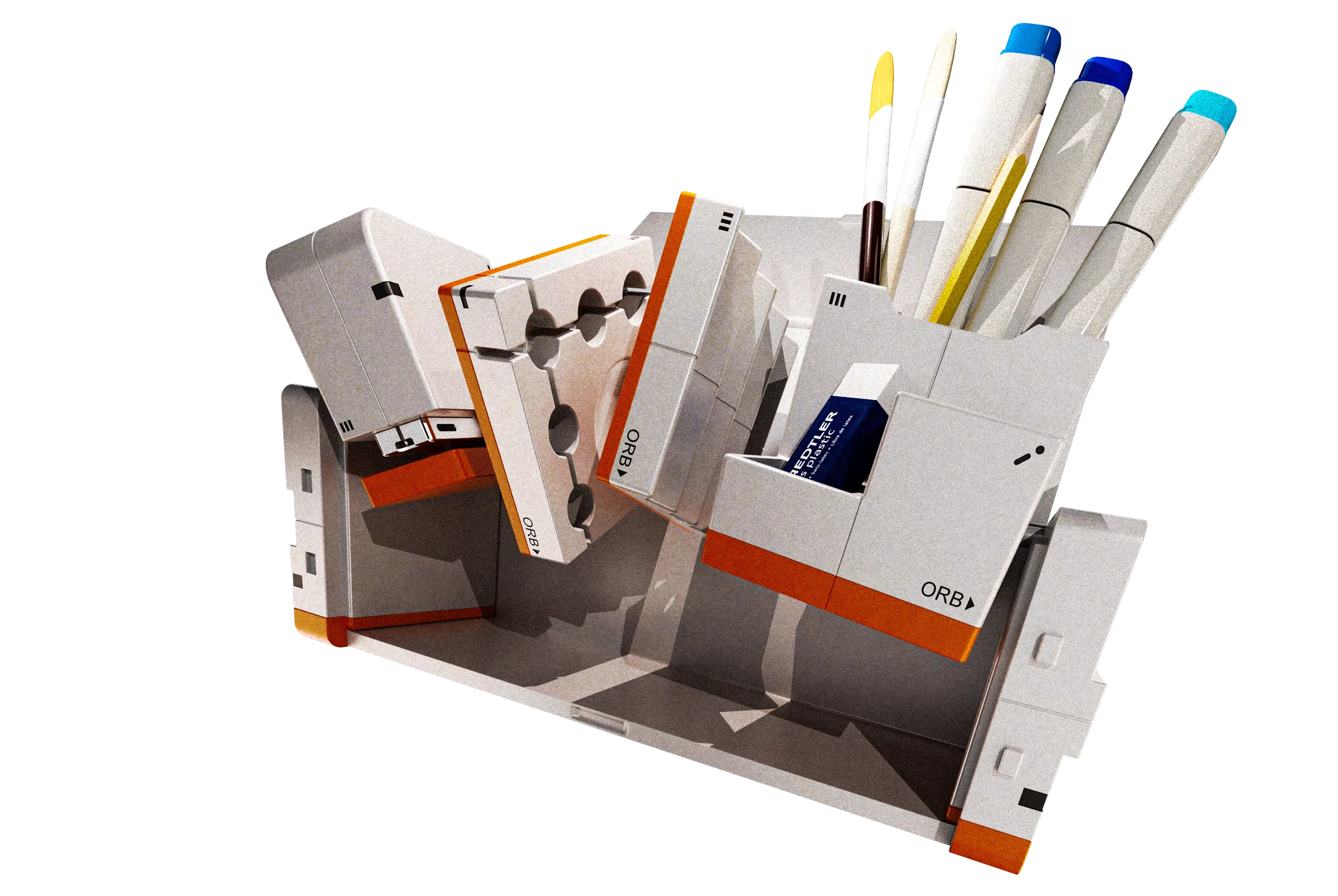
Building on insights into how object placement influences perception and workflow, ORBIT-1 offers a versatile modular ecosystem. Grid-aligned cuboid modules, some for storage and others as functional tools, can be freely rearranged to reflect individual habits and priorities.
Embedded magnets allow each module to attach securely to the case or to other modules, giving users the flexibility to create a personalised layout that adapts to any environment while maintaining order and accessibility.
06The case
Anchoring the Workspace: Case Module
The ORBIT-1 case not only acts as a storage system, but functions as a module in its own right, forming part of the user’s workspace. Its hinges click into place at pre-determined angles, providing a consistent auditory cue that helps signal the brain it’s time to focus.
This subtle sensory feedback supports cognitive ergonomics by reinforcing routine, aiding task readiness, and creating a sense of stability across different environments. With three main forms, the case allows users to customise their workspace to their own needs.
1Closed Storage
Magnetically closed, this form is primarily for transport and storage of other modules. Capacity of 3 grid spots.
2Tiered Step Setup
For standard use in small areas, this form allows for visibility and accessibility through a vertical platform. Capacity of 6 grid spots.
3Vertical Wall Setup
For ideation space, this form accommodates sticky notes or other items, regardless of the environment. It has a capacity of 3 to 5 grid spots.
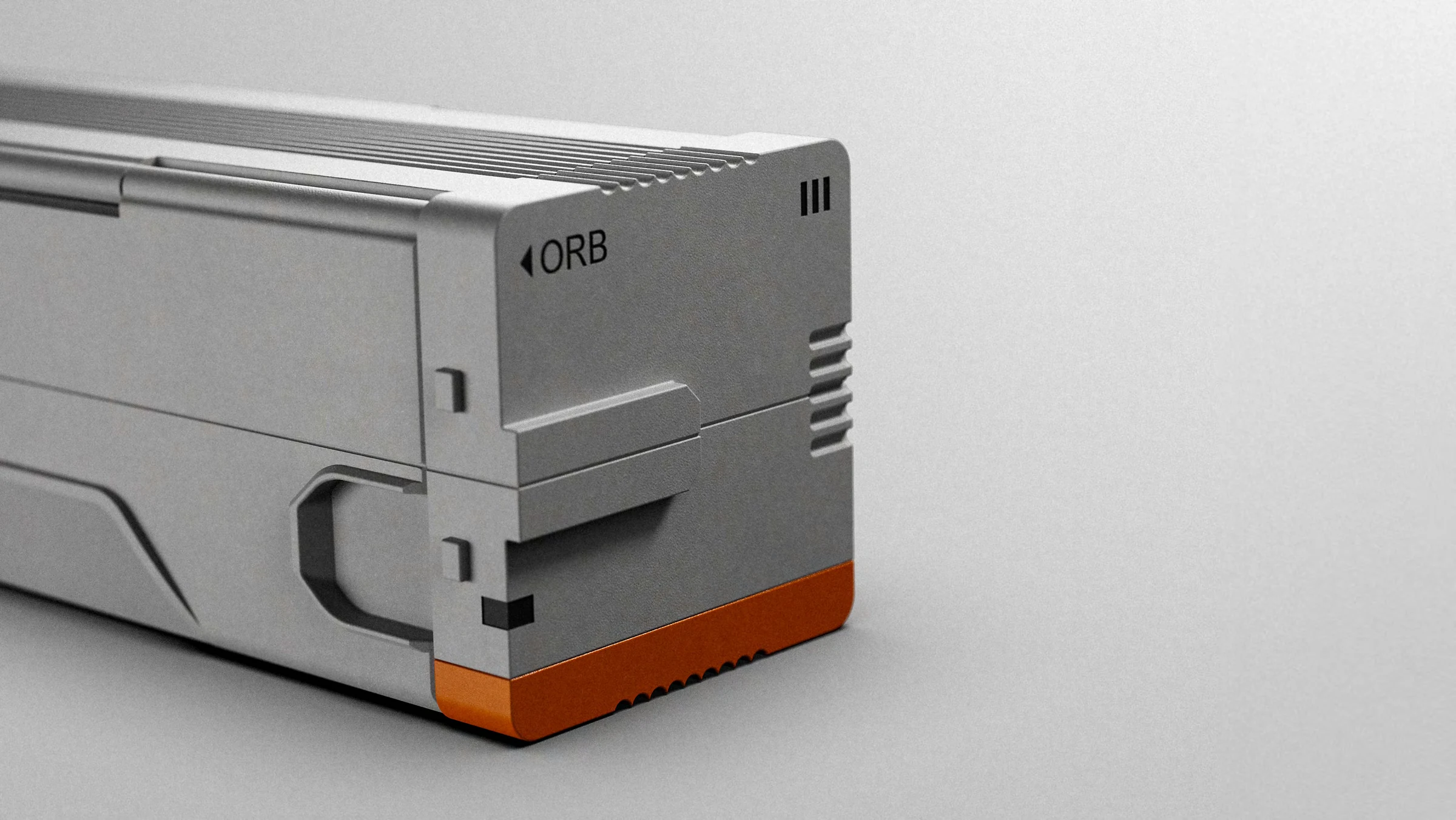
Colour, material and finish
- ABS (Acrylonitrile Butadiene Styrene)
- Pantone Cool Gray 10 C, semi-gloss matte
- ABS (Acrylonitrile Butadiene Styrene)
- RAL 2008 Bright red orange, matte
- Pad Printed UV-Curable Ink
- Pantone Black 6 C, matte
07Ideation
08Prototype
Materialised Prototype
Low quality printed prototypes served as a tool to test proportions and ergonomics, leading to the updated design which was created using 3D printed material and post processing.
09Outcome
ORBIT-1 gives people who move between home, office and shared spaces a familiar, ordered desk wherever they set up. A folding case and magnetic, grid-aligned modules keep the same layout in every location. The project ran from quick printed proportion tests through to a 3D printed, post-processed prototype.